[ad_1]
Why do eclipses are available pairs?

Photo voltaic and lunar eclipses are inclined to happen in shut proximity to 1 one other when the moon reaches an ascending or descending “node” in its orbit of Earth. These invisible factors in house exist the place the moon’s tilted orbit crosses the the flat airplane on which our planet orbits the solar, which is called the ecliptic.
When this occurs, we expertise an “eclipse season”, the place there’s a photo voltaic eclipse throughout the brand new moon and a lunar eclipse throughout a neighboring full moon part, because the Earth and moon are lined as much as go between each other and the solar. An eclipse season may also happen within the reverse order, with a lunar eclipse previous a photo voltaic eclipse.
Learn extra: Why solar and lunar eclipses come in pairs — and what an eclipse season really is.

Anthony Wooden
Wish to {photograph} the lunar eclipse? Listed here are our prime images ideas
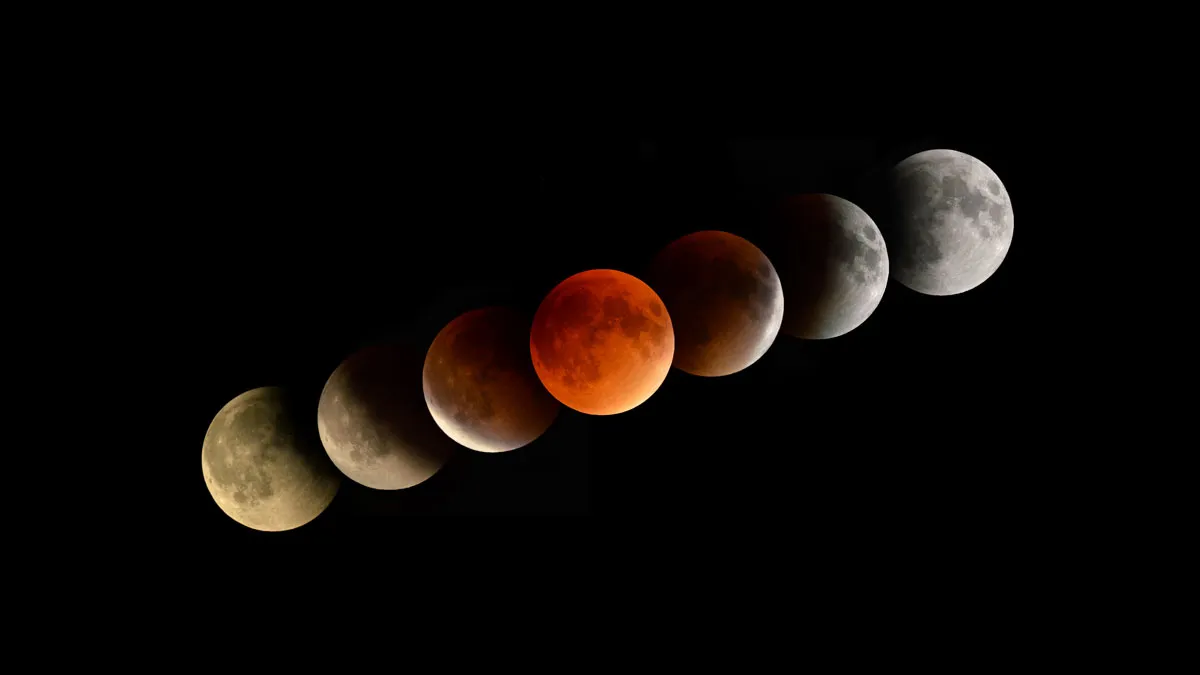
Planning to observe the deep partial lunar eclipse on Aug. 27-28? Why not strive capturing it on digicam too? Photographing a lunar eclipse is significantly simpler than photographing a photo voltaic eclipse — you do not want any particular filters to securely {photograph} the moon. However getting a pointy, well-exposed shot because the moon darkens and takes on a reddish hue can nonetheless be tough, notably as mild ranges change all through the eclipse.
Just a little preparation can go a good distance. Our guide to photographing a lunar eclipse covers every part you have to know, from choosing the proper gear and digicam settings to specializing in the moon and getting artistic with composition.

What time is the partial lunar eclipse?

Planning to observe the deep partial lunar eclipse this week? You will need to ensure you’re trying up on the proper time.
The eclipse begins at 9:23 p.m. EDT on Aug. 27 (0123 GMT on Aug. 28), when the moon enters Earth’s faint outer shadow, referred to as the penumbra. From then, the eclipse will deepen and turn out to be extra seen over a number of hours because the moon passes into Earth’s darker umbral shadow, in the end leaving 96.2% of the lunar floor lined at its peak.
For key timings and when precisely to search for, take a look at our information on when the partial lunar eclipse will occur.
What is going to occur throughout every stage of the partial lunar eclipse?

A partial lunar eclipse has 5 distinct phases that happen concurrently for everybody on the evening facet of Earth as our planet slips between the solar and its pure satellite tv for pc through the full moon part.
The eclipse begins as Earth’s outer penumbral shadow subtly darkens the moon, after which the internal umbral shadow reveals our planet’s curved silhouette because it advances throughout the lunar disk.
Learn extra: What to expect from each stage of the partial lunar eclipse on Aug. 27-28
Anthony Wooden
3 days to go! This is every part you have to know

The deep partial lunar eclipse is just some days away, so now could be the proper time to start out planning how you are going to view the “nearly blood moon”.
At most eclipse, 96.2% of the moon’s floor can be lined by Earth’s darkish central shadow referred to as the umbra. Whereas the moon will not be utterly eclipsed — so this is not technically a “blood moon” — a lot of the lunar floor is predicted to tackle a reddish-orange hue, with only a skinny sliver remaining brightly illuminated.
Try our complete guide to the Aug. 27-28 partial lunar eclipse to ensure you’re prepared for the “nearly blood moon”.
The right way to view a partial lunar eclipse

One of many great issues a few lunar eclipse is that it may be witnessed by everybody who occurs to be on the evening facet of Earth because it happens, climate allowing.
You do not want any particular gear like eclipse glasses to benefit from the present. Merely step exterior and look as much as see Earth’s curved internal shadow crawl throughout the moon in a spectacular show of orbital mechanics.
Desire a nearer look? No downside! It is utterly secure to level a pair of binoculars or a telescope on the moon throughout a lunar eclipse. Doing so gives you a magnified view of the colossal craters and darkish lunar seas that mark the moon’s close to facet as they fall throughout the umbral shadow.
Anthony Wooden
The place will the Aug. 27-28 partial lunar eclipse be seen?

The excellent news is that in contrast to a photo voltaic eclipse, a lunar eclipse may be seen from anyplace the moon is above the horizon. Meaning tens of millions of skywatchers worldwide can have an opportunity to witness not less than a part of the Aug. 27-28 eclipse, climate allowing.
The most effective views can be from North and South America, the place the complete eclipse can be seen. Throughout Europe and Africa, the eclipse takes place earlier than daybreak on Aug. 28, with the moon setting through the latter phases of the occasion.
Learn extra: Partial lunar eclipse August 2026: Where will it be visible from?
Why this partial lunar eclipse is one you will not need to miss

When most individuals hear the phrases “partial lunar eclipse,” they may typically assume it will likely be much less spectacular than a complete eclipse, and probably not well worth the effort to try to see it. However the Aug. 27-28 eclipse is something however peculiar.
At most eclipse, 96.2% of the moon can be immersed in Earth’s umbra, the darkest a part of our planet’s shadow. Meaning solely a skinny sliver of the lunar floor will stay straight illuminated by the solar, whereas the remainder of the moon will tackle a deep reddish-orange hue.
Should you miss this one, you will have to attend till Dec. 31, 2028 for one more lunar eclipse that rivals it in spectacle. So whether or not you are planning on staying up late within the US or setting your alarms early in Europe, that is one skywatching present that is properly value making time for!
1 week to go till the deepest partial lunar eclipse till 2028

We’re formally one week away from among the finest skywatching occasions of the 12 months!
On the night of Aug. 27 (for North America), or the early hours of Aug. 28 (for western Europe), Earth’s shadow will creep throughout the complete moon throughout a really deep partial lunar eclipse. At most eclipse, 96.2% of the moon can be immersed in Earth’s darkish central shadow.
The eclipse can be seen, not less than in some half, from North and South America, Europe, Africa and elements of western Asia, climate allowing. Observers within the Americas are well-positioned for the very best views whereas skywatchers throughout Europe might want to look towards the western horizon earlier than dawn because the eclipse reaches its peak.
Learn extra: A 96% partial lunar eclipse is just 1 week away: Here’s what you need to know.
[ad_2]
Source link